


Why Disposable Pads Cause Waste: The Full Picture
Most people know disposable pads end up in the trash. Fewer realize that understanding why disposable pads cause waste goes far beyond the bin. A standard disposable pad is about 90% plastic, built from materials engineered to be durable. That durability doesn’t stop working after you throw the pad away. It keeps going for centuries. The environmental impact of pads spans landfill accumulation, microplastic pollution, soil damage, and toxic air emissions. This article breaks down every layer of that problem and what you can do about it.
Table of Contents
- Key Takeaways
- Why disposable pads cause waste: material composition
- Environmental pathways: where pad waste goes
- Alternatives to disposable pads: a direct comparison
- Practical steps to reduce pad-related waste
- My perspective on this issue
- Make the switch with Natissy
- FAQ
Key Takeaways
| Point | Details |
|---|---|
| Plastic-heavy composition | Disposable pads are mostly polyethylene and polypropylene, materials that do not biodegrade naturally. |
| Century-scale persistence | Pads take 500 to 800 years to break down in landfills, fragmenting into microplastics instead of disappearing. |
| Soil and water damage | Pad contamination reduces soil organic matter by 85% and microbial activity by over 99% within months. |
| Biodegradable options exist | Plant-based pads can degrade up to 95% within 60 days under the right conditions, though real-world results vary. |
| Reusable pads cut waste substantially | Switching to washable, organic cotton pads removes hundreds of disposables from the waste stream per person per year. |
Why disposable pads cause waste: material composition
The root cause of the waste problem is not how many pads people use. It is what pads are made of.
A conventional disposable pad contains several layers, each serving a specific function. The top sheet that sits against your skin is typically made from polyethylene. The acquisition layer underneath uses polypropylene fibers. The absorbent core relies on superabsorbent polymers (SAPs), synthetic compounds that hold many times their weight in fluid. The leak-proof back sheet is again polyethylene.
Every one of those layers is a non-biodegradable polymer that resists the microbial and chemical processes that break down natural materials. Wood rots. Cotton degrades. Polyethylene does not. Synthetic fibers physically block microbial access to any natural content in the pad, further slowing any breakdown that might otherwise occur.
What actually happens to these plastics over time is fragmentation, not decomposition. Sunlight weakens plastic, causing it to crack into smaller and smaller pieces until you have microplastics and nanoplastics invisible to the naked eye. Those particles do not stop existing. They enter soil, water, and eventually the food chain.
- Polyethylene (top sheet and back sheet): extremely resistant to biological degradation
- Polypropylene (acquisition layer): synthetic fiber that blocks moisture but persists indefinitely
- Superabsorbent polymers (absorbent core): partially natural in origin but bound by synthetic cross-linkers
- Adhesive strips and packaging: additional plastic and silicone components rarely accounted for in waste estimates
Pro Tip: Check ingredient disclosures on pad packaging. Brands that list materials openly are generally more accountable for what ends up in the environment.
The combined weight of plastic per pad is small. Multiplied across an average menstruating person’s lifetime, roughly 11,000 to 16,000 pads, the volume is substantial. That is the structural reason how pads contribute to waste at a scale most consumers never see.
Environmental pathways: where pad waste goes
Disposal is not the end of the problem. It is where the problem accelerates.
Landfill persistence and microplastic release
The majority of used pads go to landfills. In that environment, decomposition slows dramatically because landfills are low in oxygen and microbial activity, the exact conditions plastics need to fragment even minimally. The 500 to 800 year breakdown estimate assumes some environmental exposure. In a sealed landfill, persistence could be longer.
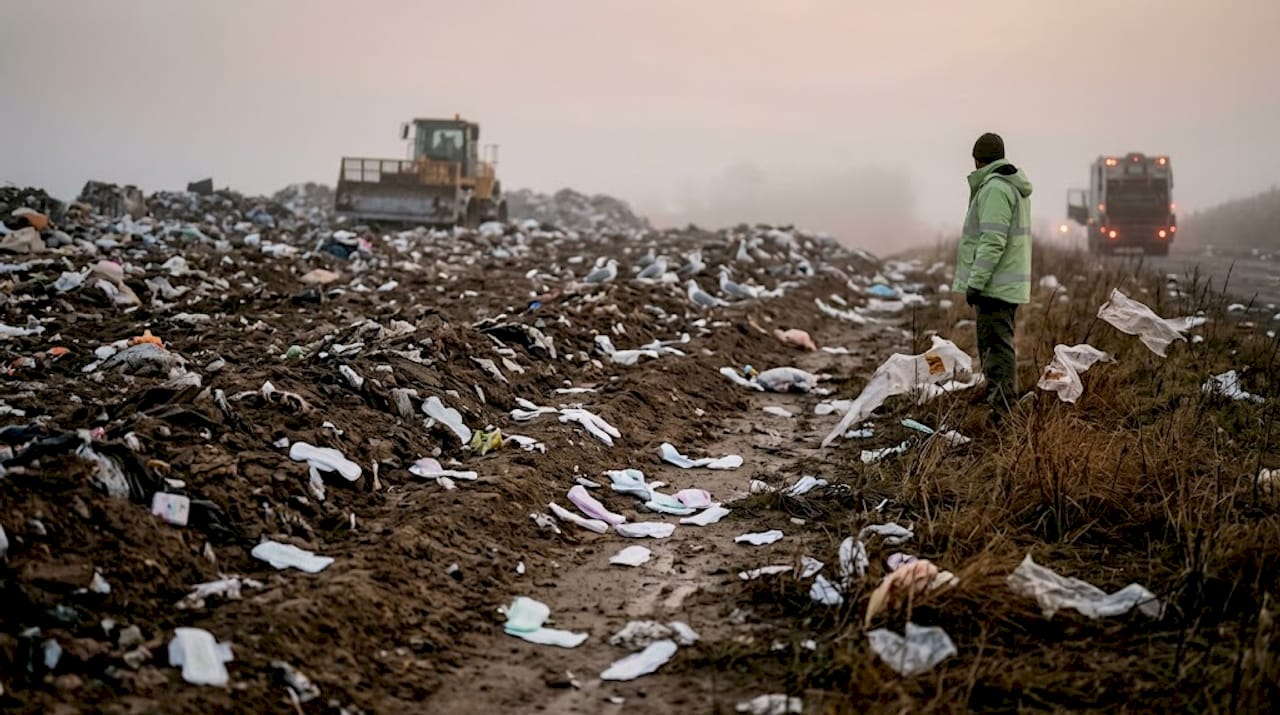
As pads fragment, microplastics leach into surrounding soil and groundwater. Microplastics contaminate soil and water and accumulate through bioaccumulation in plant roots, invertebrates, fish, and eventually humans. The waste created by menstrual products does not stay contained in the landfill. It migrates.
Soil ecosystem damage
A 2026 study tested what happens when used pads contaminate soil directly. The results were stark.
| Soil property | Baseline | After 182 days of pad contamination | Change |
|---|---|---|---|
| Organic matter | Measured baseline | Reduced by 85% | Severe loss |
| Moisture retention | Measured baseline | Reduced by 84% | Severe loss |
| Microbial count | Measured baseline | Reduced by over 99% | Near total loss |
That is not a gradual decline. That is a collapse of basic soil function within six months. Healthy soil depends on microbial populations to cycle nutrients and support plant growth. Pad contamination effectively sterilizes the ground it contacts.
Emissions from burning
In many low and middle income countries, open burning is the primary disposal method for menstrual waste. This does not avoid the pollution. It transforms it. Burning disposable pads releases methane, hydrochloric acid, sulfur dioxide, carbon monoxide, and polycyclic aromatic hydrocarbons into the air. These are not trace compounds. They are recognized respiratory hazards and carcinogens.
Pro Tip: If you are in an area where open burning is practiced, advocating for sealed community collection bins is a more achievable short-term step than waiting for industrial waste infrastructure.
The environmental burden of disposable pads is not a single problem. It is three overlapping ones: physical waste volume, chemical soil and water contamination, and air pollution from burning.
Alternatives to disposable pads: a direct comparison
The good news is that alternatives to disposable pads have improved significantly and offer real, measurable environmental benefits.
Biodegradable pads
Biodegradable pads use plant-based materials like water hyacinth, bamboo, or organic cotton instead of petroleum-derived plastics. Research on water hyacinth pads shows nearly 70% degradation after 40 days and up to 95% after 60 days under controlled test conditions. That is a meaningful difference from the century-scale persistence of conventional pads.
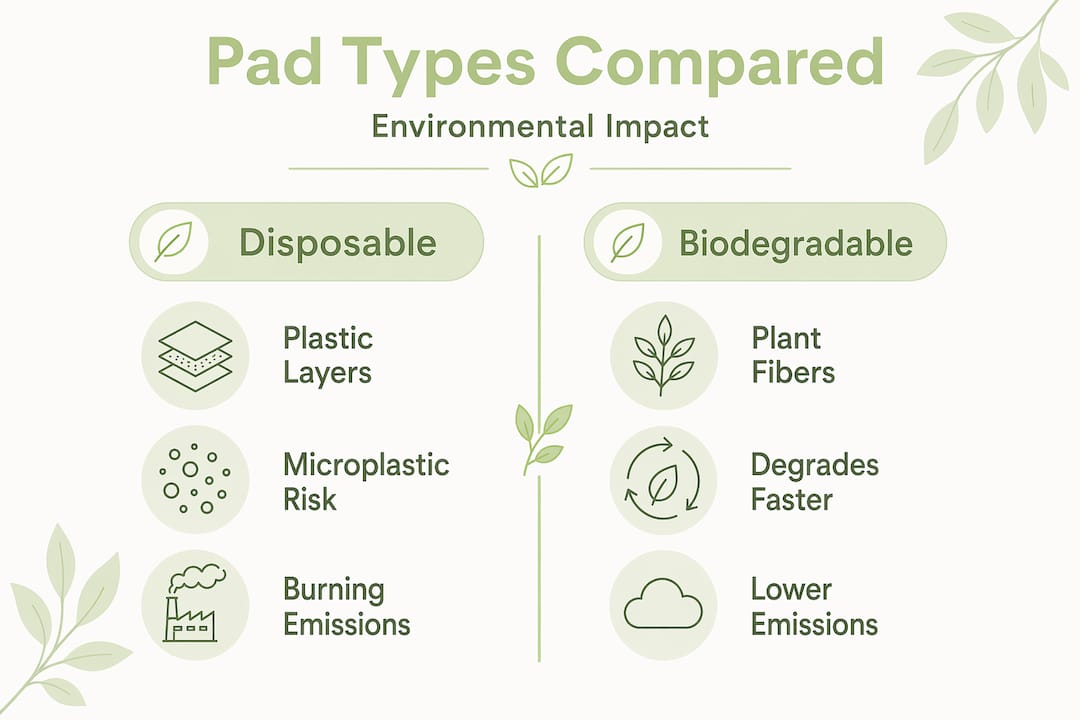
However, there is an important caveat. Real-world waste systems rarely replicate the warm, moist, aerated conditions of a test lab. Most biodegradable pads sent to landfills will degrade faster than conventional pads but not as fast as the packaging claims suggest. Industrial composting gives much better results than landfill disposal.
Reusable pads and other sustainable options
Reusable cloth pads, period cups, and period underwear offer a different category of benefit. They do not ask you to optimize disposal. They remove the item from the waste stream entirely.
- Reusable cloth pads: Washable, last 2 to 5 years or longer, generate no single-use waste per cycle
- Menstrual cups: Silicone or rubber construction, can last up to 10 years, generate almost no ongoing waste
- Period underwear: Absorbent undergarments that replace pads and liners, washable and reusable
- Organic cotton disposables: Still single-use but free of synthetic polymers; degrade faster and do not release the same chemicals
The lifecycle math is straightforward. One person using reusable pads for three years displaces roughly 400 to 600 disposable pads from the waste stream. Multiply that across a household or a community and the reduction becomes significant.
| Product type | Degradation time | Single-use waste | Key tradeoff |
|---|---|---|---|
| Conventional disposable pad | 500 to 800 years | Yes | Convenience vs. high waste |
| Biodegradable disposable pad | 40 to 60 days (ideal conditions) | Yes | Lower impact but still single-use |
| Reusable cloth pad | Not applicable | No | Initial cost, ongoing use |
| Menstrual cup | Not applicable | No | Learning curve, high durability |
Practical steps to reduce pad-related waste
Switching products overnight is not always practical. But there are concrete steps you can take right now to reduce the environmental harm of menstrual waste.
- Stop flushing pads. Flushed pads block sewage systems and release plastic directly into waterways. Always wrap used pads and dispose of them in a sealed bin.
- Avoid open burning where possible. If you have access to formal waste collection, use it. Open burning converts solid plastic waste into airborne chemical waste, which is a net loss for local air quality and health.
- Try biodegradable pads as a transitional step. They are not perfect, but they carry a lower material burden than conventional pads, especially if your local area has industrial composting access.
- Pilot one reusable product per cycle. You do not have to commit fully on day one. Try using a reusable cloth pad for lighter days while keeping your current routine for heavier days. Most people find the adjustment straightforward within one to two cycles.
- Choose brands with transparent ingredient lists. Products that disclose their materials are more likely to be accountable for environmental claims. Check whether pads carry certifications like GOTS (Global Organic Textile Standard) or OEKO-TEX.
- Advocate for better waste infrastructure. Consumer choices matter, but so does the system those choices operate within. Supporting local composting programs, zero-waste initiatives, and period product education campaigns addresses the problem at scale.
Learning more about period care myths can also help you separate genuine eco-claims from greenwashing, which is genuinely useful when navigating product choices.
My perspective on this issue
I’ve spent years reading the research on menstrual waste, and the number that still surprises me most isn’t the 500 to 800 year degradation estimate. It’s the soil microbial data. A 99% reduction in microbial counts within 182 days tells me that pad contamination doesn’t just add to a waste problem. It actively degrades the systems we depend on for food and water.
What I’ve found, though, is that data alone rarely changes behavior. I’ve seen people read the statistics, feel concerned, and then buy the same product the next week because the alternatives felt unfamiliar or inconvenient. That gap between knowing and doing is real, and I think it deserves honesty rather than judgment.
The practical truth is that switching to reusable pads is not complicated once you try it. The first wash feels like the biggest hurdle. After that, it becomes routine. The cultural resistance to washable period products is a holdover from decades of marketing that positioned disposability as hygiene. It isn’t. A well-washed organic cotton pad is not less clean than a plastic-wrapped disposable. It is just less profitable for someone else.
Policy matters too. Without investment in industrial composting, waste collection infrastructure, and transparent product labeling, individual choices can only accomplish so much. But individual choices still matter, and they add up faster than most people expect.
— Gaurav
Make the switch with Natissy
If you are ready to reduce the waste from your menstrual routine, Natissy offers a practical starting point. The organic cotton reusable pads are made without synthetic polymers, designed for sensitive skin, and built to last for years of use. Natissy also offers bamboo reusable pads for those who prefer a lighter, ultra-soft option.
Both product lines are washable, toxin-free, and leak-protected. Using them consistently over one cycle period removes dozens of plastic-heavy disposables from your waste footprint. For a full overview of what Natissy offers across pad sizes, liners, and accessories, visit the Natissy store directly.
FAQ
Why do disposable pads take so long to break down?
Disposable pads are made primarily from polyethylene and polypropylene, synthetic plastics that resist microbial decomposition. In landfills with low oxygen levels, pads persist for 500 to 800 years and fragment into microplastics rather than disappearing.
Are biodegradable pads actually better for the environment?
Yes, but with conditions. Plant-based pads degrade up to 95% within 60 days in ideal composting conditions. In standard landfills, degradation is slower, though still significantly faster than conventional plastic-heavy pads.
What happens when disposable pads are burned?
Burning releases toxic gases including methane, sulfur dioxide, and polycyclic aromatic hydrocarbons. These compounds affect air quality and carry known health risks, making open burning a poor disposal option for disposable pads.
How much waste does switching to reusable pads actually prevent?
One person using reusable pads over three years can remove 400 to 600 disposable pads from the waste stream. Each conventional pad avoided also eliminates its associated plastic, adhesive, and packaging waste.
Do microplastics from pads really enter the food chain?
Yes. Microplastics accumulate through bioaccumulation, moving from contaminated soil and water into plant roots, invertebrates, fish, and eventually human food sources.